ALIVE Coaching Model
There is a persistent tension at the heart of professional coaching: the field has developed rich conceptual frameworks for understanding human change, yet the most widely taught models often reduce that complexity to a sequence of steps. The client arrives, articulates a goal, receives structured questions, leaves with a plan. The loop is clean. It is also frequently insufficient.
What gets lost in the clean loop is the body, the system, the relational field, and the messy reality that human beings rarely change because they have thought their way to clarity. They change, sustainably, when something shifts in how they feel in a context, how they occupy their role, how they respond to new experiments. This distinction is not merely philosophical. It has practical consequences for what coaching looks like session-by-session.
"The ALIVE model is an attempt to hold two things at once: rigorous enough to orient a complex engagement, and open enough to follow a human being into whatever is actually alive for them today."
The ALIVE Coaching Model was developed out of exactly this tension: a need for a framework that could serve individual transformation with the full depth it deserves: the somatic inquiry of a presence-centered session, the systemic awareness of the relational and role contexts the client inhabits, and the self-leadership dimension of how a person relates to their own authority, strengths, and agency. It is not a departure from existing coaching wisdom; it is an integration of it, grounded in the author's training in the Pantarei Approach (somatic coaching), Systemic Business Coaching, and over a decade of practice across leadership and personal development contexts.
This article is addressed to coaches, particularly those with a systemic or somatic orientation, working with individual clients in leadership roles, career transitions, or personal development. It explores the five phases of ALIVE in depth, illustrates each with practical tools and methods, and locates ALIVE honestly within the landscape of existing frameworks.
Presence, System, and Ethics
Before any model can be useful, its epistemic commitments must be named. ALIVE rests on three foundational premises that shape everything downstream.
1. Presence as the primary instrument
In somatic coaching traditions, and specifically in the Pantarei Approach, the coach's quality of attention is not a warm-up to the real work, it is constitutive of it. The grounded, attuned presence of the coach creates a regulatory field in which the client's nervous system can settle, open, and access material that would otherwise remain defended. This is not metaphorical. Research in interpersonal neurobiology (Siegel, 2010; Ogden et al., 2006) points to the co-regulatory function of relational attunement: we regulate each other through resonance, gaze, breath, and pace.
ALIVE names this explicitly in the A phase. Attunement to the client's present moment is not merely good contracting hygiene, it is a witnessing act. How does this person arrive? What is their rhythm? Where is the energy high, and where is it absent? Acknowledging what is present is a deeply human act that shapes everything that follows.
2. Change is systemic, not individual
A second commitment is that individuals do not change in isolation. They shift, or fail to shift, within relational fields that have their own momentum. Pattern loops sustain current realities more effectively than individual willpower can disrupt them. This means that a coaching engagement that focuses entirely on the individual, without mapping the system they inhabit, is working at a fraction of its potential leverage.
Systemic Business Coaching (Kröger & Sauer, 2017; Varga von Kibéd & Sparrer, 2009) offers tools for making these fields visible: circular questioning, constellation work, role and influence mapping, shadow agreement identification. ALIVE integrates these in the L phase, where the coaching moves from the client's self-report to a wider cartography of their reality.
"Patterns sustain reality more than intentions do. Mapping feedback loops is more useful than debating beliefs."
3. Ethics as ongoing practice, not compliance checkbox
The third commitment concerns ethics, and it is more dynamic than most frameworks acknowledge. ALIVE distinguishes contracting at three levels: macro (the engagement), meso (each session), and micro (moment-to-moment consent), precisely because the ethical situation changes as the work deepens. What a client consented to at intake may not cover what emerges in session six. The coach who builds micro-contracting into their moment-to-moment practice ("I'd like to slow down here, is that okay?") creates a fundamentally different relational context than one who contracted at the start and considers themselves covered.
This is particularly relevant when a third party is involved in the coaching relationship, whether an employer, an institution, or a sponsor, where the triadic dynamic generates genuine ethical complexity. ALIVE requires the coach to map this triangle explicitly, not assume alignment.
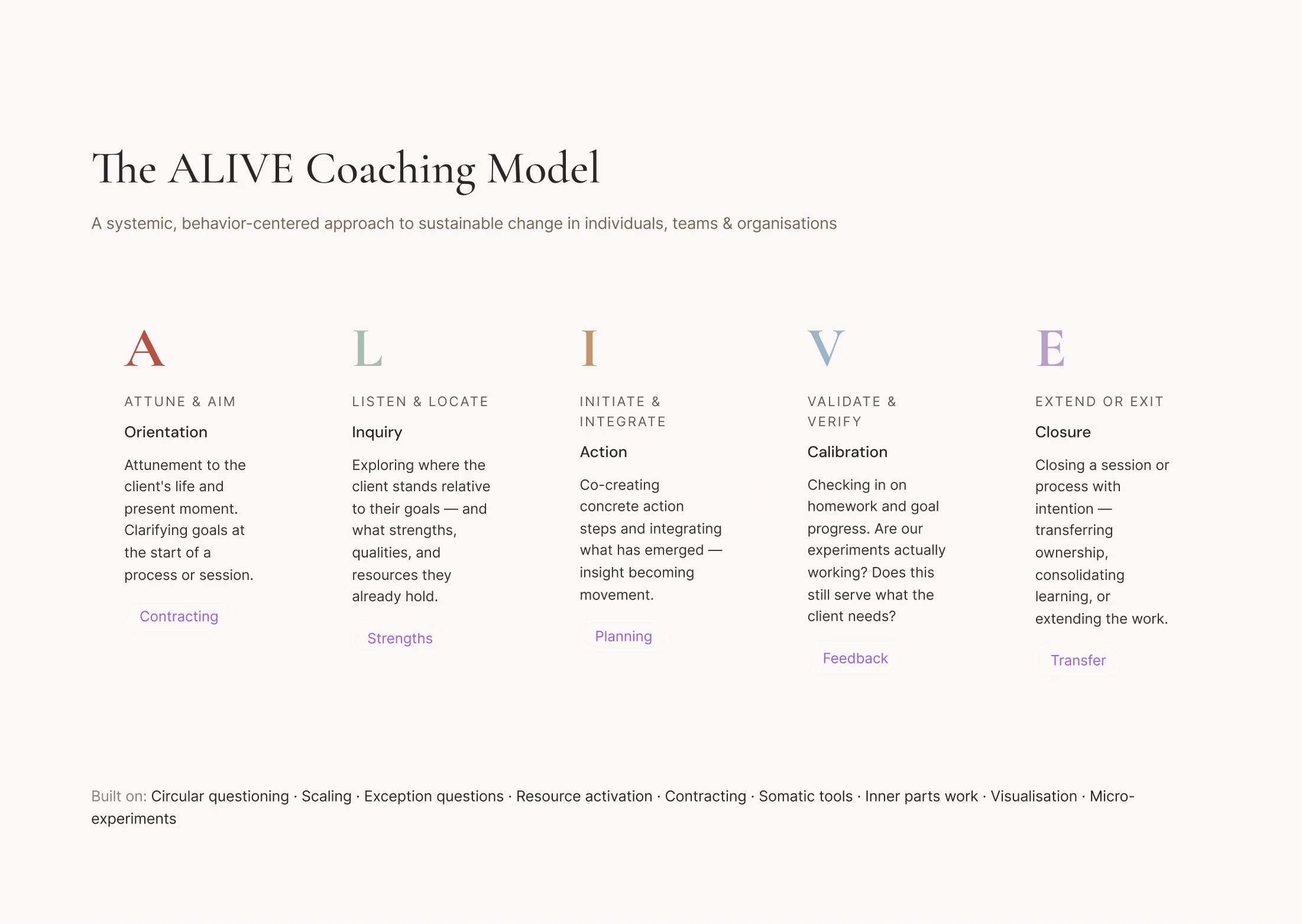
Phase A — Attune & Aim
Every session, and every engagement, begins here. Attunement is both relational and somatic: the coach arrives fully present, noting the client's breath, energy, and nervous system state before any content is discussed. From a somatic perspective (drawing on Levine's work on the window of tolerance and Gendlin's focusing approach), it matters enormously whether the client arrives in a regulated, ventral vagal state, curious, open, connected, or in sympathetic activation (anxious, pressured) or dorsal collapse (flat, withdrawn). Interventions that might land beautifully in one state will have little effect, or even cause harm, in another.
Aim is the contracting function: clarifying what the client actually wants from this session or process, and importantly, distinguishing between presenting goals ("I want to manage my time better") and deeper goals ("I want to feel less like I'm always failing"). The miracle question from Solution-Focused Brief Therapy is often useful here: "If you woke up tomorrow and this problem was gone, what would be the first thing you'd notice?"
Phase L — Listen & Locate
With orientation established, the coach moves into a mode of deep inquiry, not solution-seeking, but cartography. Listen & Locate maps both the internal landscape (where does this client stand in relation to their goal? what resources, strengths, and qualities are already present?) and the external landscape (what patterns, roles, and relationships constitute the system they inhabit?).
The somatic dimension here involves tracking body signals as data. Where does the client feel contracted? Where do they expand? A client describing a conflict situation while their jaw tightens and their breathing shallows is giving information that no amount of verbal inquiry will surface as clearly. The Pantarei Approach's training in "giving space to the full story" and “working with and through the body” is particularly relevant in this phase.
The systemic dimension involves pattern loop mapping (trigger → reaction → reinforcement → outcome), iceberg analysis (what visible behaviours sit on top of hidden fears, loyalties, and identity threats?), and circular questioning: "If I asked your colleague what they'd lose if this changed, what would they say?"
Phase I — Initiate & Integrate
This is the action phase, but action in the ALIVE framework means something specific. It does not mean grand commitments or comprehensive plans. It means the smallest possible experiment that will generate learning about the system. The micro-shift design canvas provides a format: When X happens → we will respond with Y → so that Z becomes possible.
The integrate half of this phase is often under-resourced in other models. Integration means returning to what has already shifted, the insight from last session, the experiment tried this week, and weaving it consciously into the client's sense of themselves and their capabilities. Resource activation: finding allies, existing routines, contexts where trust is already higher is a key tool here (drawing on solution-focused traditions).
Phase V — Validate & Verify
Validation treats the system's response to an experiment as feedback rather than verdict. Resistance is not failure; it is information about where the pattern is most deeply embedded. The V phase asks the client to scan for what shifted (what got easier, what became visible), what didn't (where the old pattern re-emerged), where resistance appeared and what that reveals about what to try next.
Scaling questions are valuable here, not to reduce complex experience to a number, but to track movement: "You said you were at a 4 last week. Where are you now? What moved you a half-step higher?" The 0.5 step deserves particular attention: it surfaces micro-changes that the client's inner critic would otherwise dismiss, and it builds a relational language for incremental progress.
Somatic V-Phase Inquiry: Inviting the client to locate their progress in the body: "When you think about the week, where do you feel the change? Even a subtle shift, what does it feel like in your chest, your shoulders, your feet?" This prevents the V phase from becoming purely cognitive and anchors learning somatically.
Phase E — Extend or Exit
Closure in coaching is underrated and often rushed. The E phase creates intentional space for the question: does the work continue, extend in a new direction, or reach its natural completion? From a systemic perspective, a well-closed engagement transfers ownership of the new pattern to the client (or team), builds in relapse normalization (what does regression look like, and what is the recovery action?), and celebrates the distance traveled rather than focusing only on what remains.
The distinction between Extend and Exit matters: extending is not a failure of completion. It can be the appropriate systemic response to discovering, near the end of one process, that a related but distinct layer has surfaced. A good coach names this explicitly rather than allowing scope to drift.
Matching Instruments to Phases
The following tools are not prescriptive. They are possibilities that serve different clients, moments, and contexts. A skilled coach holds this repertoire lightly, reaching for what is genuinely needed rather than what the model says should come next.
| Phase | Tool / Method | What it does |
|---|---|---|
| A — Attune & Aim | Grounding check-in | Somatic arrival practice. Feet on the floor, breath, present-moment orientation. Establishes regulatory baseline before any content work. |
| A — Attune & Aim | Miracle question (SFBT) | Solution-focused goal clarification. Bypasses problem-saturation and elicits the client's own image of desired change. |
| A — Attune & Aim | Three-level contracting | Macro (engagement), meso (session), micro (moment). Explicit consent layers that protect autonomy throughout the process. |
| A — Attune & Aim | System temperature check | Surfaces the client's current field: where energy is high, where it is absent, what conversation is being avoided. Creates honest orientation before goal work begins. |
| L — Listen & Locate | Circular questioning | Systemic inquiry into relational patterns. "What would your partner say?" Externalises the system and surfaces feedback loops. |
| L — Listen & Locate | Pattern loop mapping | Trigger → Reaction → Reinforcement → Outcome. Makes feedback loops visible and selectable as intervention points. |
| L — Listen & Locate | Iceberg analysis | Visible behaviour over hidden beliefs, fears, and loyalties. Key question: "What must we believe for this to make sense?" |
| L — Listen & Locate | Resource activation | Mapping client strengths, allies, previous wins, and high-trust contexts. Anchors change work in existing capacity. |
| L — Listen & Locate | Somatic tracking | Reading body signals as systemic data: contraction, expansion, breath shifts. |
| L — Listen & Locate | Constellation inquiry | Systemic representations of relational fields. Used selectively; particularly useful in complex stakeholder or family dynamics. |
| I — Initiate & Integrate | Micro-shift design canvas | "When X → respond with Y → so Z is possible." The smallest experiment that will generate real systemic data. |
| I — Initiate & Integrate | Boundary scripts | Concrete, rehearsable language for new behaviours. "I'm not available for that this week." Bridges insight to embodied action. |
| I — Initiate & Integrate | Somatic rehearsal | Embodying the new behaviour in session, not just planning it. Activates procedural memory, making the experiment more likely to transfer. |
| I — Initiate & Integrate | Inner parts work | Working with sub-personalities or inner critics that resist change. Used selectively and within ethical scope, not as therapy. |
| V — Validate & Verify | Scaling questions (0.5 steps) | Tracking incremental progress without flattening complexity. The 0.5 step validates micro-change that clients routinely dismiss. |
| V — Validate & Verify | Exception questions | "When was the last time this wasn't a problem?" Locates existing competence and disrupts totalising narratives. |
| V — Validate & Verify | Somatic progress scan | Locating change in the body: "Where do you feel the shift? Even if it's very subtle, what does it feel like?" Prevents purely cognitive review. |
| V — Validate & Verify | Relapse normalization | Naming the fallback pattern before it happens. "Under pressure, we revert to X. The early warning is Y. Recovery action is Z." |
| E — Extend or Exit | Closure conversation | Structured reflection: what did we learn? What will endure? What do we stop? Explicit decision on continuation vs completion. |
| E — Extend or Exit | Identity reframe | Giving the client a new narrative about who they are now, one that integrates the change. "I am someone who trusts my own judgment." "I lead from my strengths, not from my gaps." |
| E — Extend or Exit | Ritualization | Anchoring new behaviour into daily rhythms and structures — routines, relationships, practices — so change outlasts the coaching engagement itself. |
ALIVE in Practice: Two Scenarios
Abstract frameworks only earn their keep when they can be traced through real situations. The following scenarios, both individual, illustrate how ALIVE operates in practice across two distinct leadership and self-leadership challenges: one concerned with relational patterns in an existing role, one with the deeper work of recognising one's own strengths during a life transition.
ALIVE Alongside Other Frameworks
Honest comparison requires acknowledging what each model does well, where ALIVE adds, and where it risks reinventing wheels or creating unnecessary complexity. The goal is not to assert superiority but to locate ALIVE clearly in the landscape.
| Dimension | GROW Whitmore |
COACH Zeus & Skiffington |
OSKAR SFBT-based |
CLEAR Hawkins |
4MAT McCarthy |
ALIVE |
|---|---|---|---|---|---|---|
| Somatic / Body-based | None | Minimal | None | Limited | None | Full integration + |
| Systemic / Field awareness | None | Limited | None | Some (team focus) | None | Full, with tools + |
| Leadership & self-leadership focus | Implicit | Yes (executive) | Partial | Partial (team) | Limited | Explicit, self-leadership integrated + |
| Closure & transfer phase | Implicit in W | Handled | Affirmations (A) | Yes (L phase) | Partial | Explicit, extend vs exit decision + |
| Resistance treatment | Not named | Not named | Exceptions (positive) | Limited | None | Resistance as data, mapped explicitly + |
| Ethics / contracting depth | Assumed | Brief mention | Not addressed | Some | None | 3-level contracting built in + |
| Simplicity / learnability | Very high | Medium | High | Medium | Medium | Medium requires training |
| Research / empirical base | Moderate | Limited | Strong (SFBT lineage) | Limited | Moderate | Emerging needs study |
| Measurement approach | Goal-based | Goal-based | Scaling-based | Developmental | Learning style | Multi-signal, incl. somatic + |
| Single session usability | Very high | Medium | Very high | High | Limited | High + |
What ALIVE Does Not Yet Fully Address
Intellectual integrity requires naming the gaps. The following are not rhetorical hedges, they are genuine areas where ALIVE, as it currently stands, falls short of what a mature, evidence-based framework would offer.
1. Empirical validation
ALIVE is a practitioner-developed model, grounded in field experience and theoretical integration, but it has not yet been subjected to formal empirical study. GROW, despite its practical origins, has accumulated a body of research supporting its effectiveness (Grant, 2011; Theeboom et al., 2014). SFBT, which underpins elements of the L and V phases, has an extensive evidence base. The somatic and systemic components of ALIVE draw on traditions (Pantarei Approach, Somatic Experiencing, Systemic Business Coaching) that have their own research streams, but ALIVE as an integrated model has not been evaluated. This is the most significant gap.
2. Cultural and diversity considerations
The framework was developed by a European-based coach working primarily in European and American contexts. Its assumptions about directness in contracting, self-disclosure in somatic work, and individual agency as the primary lever of change may not translate equally well across all cultural or identity contexts. Clients from high-power-distance backgrounds, collectivist frameworks, or contexts where body-based work carries stigma would require significant relational adaptation. This adaptation has not been explicitly theorised within ALIVE, and represents a meaningful gap for coaches working across cultural contexts.
Key Gap: Unlike GROW's elegantly teachable four questions, or OSKAR's memorable acronym format, ALIVE requires a richer theoretical background to deploy fully. A coach without somatic training may misuse the A phase; one without systemic training may misuse the L phase. The model's richness is also a barrier to accessibility.
3. Supervision and meta-level structure
Models like Hawkins' CLEAR and his subsequent 7-Eyed Model (Hawkins & Smith, 2006) include explicit guidance for coach supervision. ALIVE has not yet developed a supervision framework, how should coaches working within ALIVE reflect on their practice, track blind spots, or develop their somatic and systemic competencies over time?
4. Self-leadership theory
ALIVE engages self-leadership practically, particularly in how the L phase works with a client's relationship to their own strengths, authority, and agency. But it does not yet offer a coherent theory of self-leadership development. Frameworks such as Manz's self-leadership model (1986), or more recent integrations with self-determination theory (Deci & Ryan), would provide theoretical grounding for what ALIVE already does intuitively. Making this explicit would strengthen both the model's theoretical standing and its relevance to leadership coaching specifically.
5. Developmental stages
Models like Kegan's Subject-Object theory, or adult developmental frameworks (Torbert's Action Logics), offer a theory of how coaches and clients grow over time in their capacity for complexity. ALIVE works with complexity but does not yet offer a theory of how practitioners develop their capacity to hold it. This is particularly relevant for training coaches to use the model.
Structure Without Rigidity
The closing statement from the ALIVE Change Toolkit reads: "It provides structure without rigidity, and depth without abstraction. Most importantly, it keeps systems alive while they evolve." This is also the aspiration for the framework itself as a piece of knowledge in the field, not a final word, but an opening.
The coaches most likely to find ALIVE useful are those who already feel the limitation of purely cognitive, goal-focused models; who have encountered the body's role in change and want a way to integrate it professionally; who work with leaders, professionals, and individuals in transition and want a framework that honours the full human complexity of those moments, the career move shadowed by self-doubt, the leadership role haunted by old identity, the relationship with one's own strengths that has never quite been claimed. For those coaches, ALIVE is offered as a companion, something to argue with, adapt, and make genuinely their own.
"When someone shows up fully, with all their qualities and strengths, they can truly live in a way that is good for them, the people around them, and the planet. It is our honor to enable this journey back to aliveness. - Balach Hussain"
The model is young. The empirical work is ahead. The cultural adaptations are unmapped. These are invitations, not weaknesses. If this article reaches a colleague who wants to study ALIVE outcomes, design a training programme around it, or apply it in a context the author hasn't considered, that is exactly the kind of extension the E phase was designed for.
***
Gendlin, E. T. (1978). Focusing. Everest House.
Grant, A. M. (2011). Is it time to REGROW the GROW model? Issues related to teaching coaching session structures. The Coaching Psychologist, 7(2), 118–126.
Hawkins, P., & Smith, N. (2006). Coaching, Mentoring and Organizational Consultancy. McGraw-Hill Open University Press.
Levine, P. (2010). In an Unspoken Voice. North Atlantic Books.
Ogden, P., Minton, K., & Pain, C. (2006). Trauma and the Body. W.W. Norton.
Siegel, D. J. (2010). Mindsight. Bantam Books.
Theeboom, T., Beersma, B., & van Vianen, A. E. M. (2014). Does coaching work? A meta-analysis on the effects of coaching on individual level outcomes. Journal of Positive Psychology, 9(1), 1–18.
Varga von Kibéd, M., & Sparrer, I. (2000). Ganz im Gegenteil. Carl Auer Verlag.
Whitmore, J. (2009). Coaching for Performance (4th ed.). Nicholas Brealey.
Zeus, P., & Skiffington, S. (2002). The Complete Guide to Coaching at Work. McGraw-Hill.
P.S. Claude AI was used to review and simplify the narrative, as well as double check the references. All ideas are of the author’s own. If you spot any incongruencies or wrong references, please reach out and help us improve this.
